A Primer on Climbers
The Redneck Rosarian's Guide to Growing and Pruning Climbing Roses in the Deep South
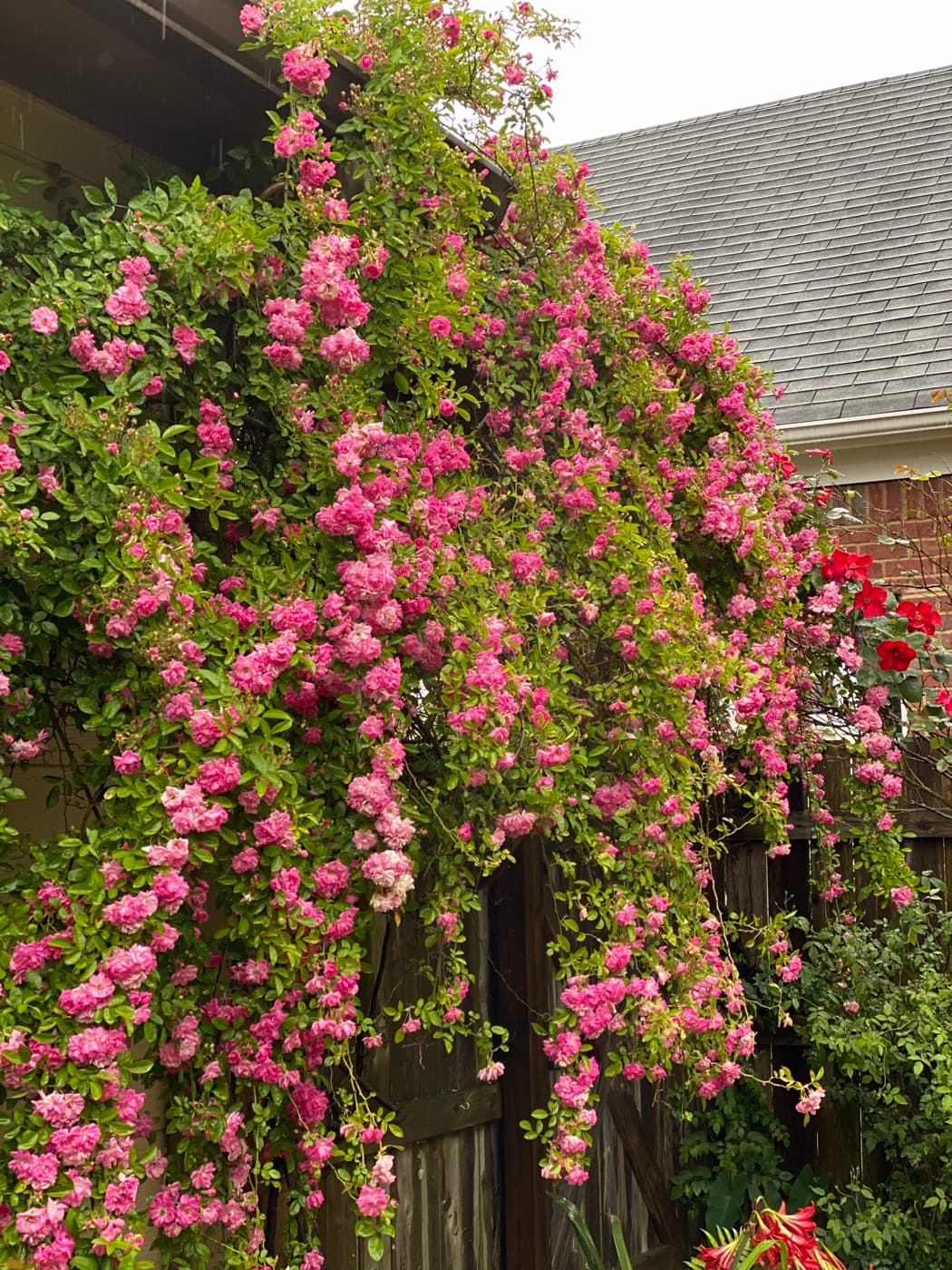
Climbing roses in the Deep South are some of the most spectacular plants you can put in a garden. But they aren't simply tall shrub roses, and treating them like one can cost you an entire season of flowers.
I've grown roses in the South for decades, and I've learned that the secret to growing great climbing roses isn't complicated. Choose the right rose. Give it something sturdy to climb. Train it properly. And, above all, learn when not to prune.
Because there's one thing every Southern gardener needs to understand: most climbing roses bloom on wood produced the previous year. Prune those canes too early and you may have just pruned away your flowers.
That's the lesson I want every gardener to understand before they pick up a pair of pruners. And yes, there's a little pantyhose involved, too.
A Southern Introduction to Climbing Roses
"You can't sling a cat in Little Rock without hitting a New Dawn." — P. Allen Smith
There may be no better description of the climbing rose. Walk through almost any Southern garden and you'll find one: climbing over an arbor, draped across a fence, crawling up the side of an old shed, or hanging from a pergola. Sometimes it's beautifully trained. Sometimes it looks like somebody threw a rose into a tree and hoped for the best.
And therein lies the problem. Climbing roses aren't difficult. They're just different. They have different growth habits, they require different pruning, they need something sturdy to climb on, and, perhaps most importantly, they need to be trained, not simply planted and left to their own devices.
I've always thought of a good climbing rose as a piece of garden architecture. A fence becomes a garden wall. An arbor becomes a destination. A pergola becomes a garden room. A plain porch suddenly looks like it belongs in an old Southern garden. But there's a trick to getting them right: you've got to learn how a climber wants to grow.
What Is a Climbing Rose?
Not every rose that gets tall is a climbing rose. A vigorous shrub rose may reach six or seven feet, a hybrid tea can occasionally send up surprisingly long canes, and some English roses can even be trained against a wall. But a true climbing rose is generally selected for its ability to produce long canes that can be trained onto a structure.
And then there are ramblers. The two are often confused, but they're not exactly the same thing. Climbing roses generally have larger flowers, and many varieties repeat bloom. Ramblers tend to be more vigorous, with flexible canes and often smaller flowers produced in large clusters. Many ramblers have one spectacular flowering period each year, although there are exceptions.
Knowing what you've planted matters, because flowering habit determines how you prune it.
Why Climbing Roses Love the Deep South
The Deep South has some real advantages for growing climbing roses. Here in Alabama, we have a long growing season, relatively mild winters, and plenty of heat to push vigorous growth. That's good news for climbers, a rose that has months to produce long, strong canes can eventually cover a considerable amount of territory.
But Southern gardeners also have challenges:
- Heat
- Humidity
- Heavy summer rain
- Periods of drought
- Disease pressure
That's why I don't choose a climbing rose simply because the catalog photograph is pretty. I'm interested in vigor, disease resistance, heat tolerance, repeat bloom, and, most importantly, how the rose actually performs in a Southern garden. That's the philosophy behind my Bulletproof Rose approach: for the Deep South, I want roses that can take our climate and still come back swinging.
The Most Important Rule: Don't Prune Climbing Roses Like Shrub Roses
If you remember only one thing from this guide, remember this: most climbing roses bloom on old wood. That means the long canes your climbing rose produced during the previous growing season may be the very canes that produce your flowers this year.
That's completely different from how many gardeners think about pruning shrub roses. With many shrub roses, late-winter or early-spring pruning encourages new growth that will flower during the coming season. But with a climbing rose that flowers primarily on old wood, cutting those mature canes back before they bloom can have a very unfortunate result: you've just cut off your flowers.
The Redneck Rule of Climbers: don't prune your climber before you see its flowers. Most climbing roses bloom on growth produced the previous year, and cutting those canes back before their spring flush can cut off the very flowers you were waiting for. Train first. Bloom second. Prune after.
There are exceptions, of course. Some climbing roses have different flowering habits, including varieties that produce significant flowers on newer growth. That's why you should always learn the flowering habit of the particular rose you're growing. But if you're unsure, don't give an established climber a drastic early-spring haircut just because it looks messy. Wait. Let it bloom. Then decide what needs to be pruned.
Think of a Climbing Rose as a Framework
When I plant a climber, I'm not thinking about how pretty it's going to look this spring. I'm thinking about what I want it to look like three years from now.
The major canes are the bones of the plant. Choose your strongest canes, train them onto the structure, spread them out, and give them room. The smaller flowering shoots develop along those canes. Over time, you're building a permanent framework, and that's when a climbing rose really starts to earn its keep.
How to Train Climbing Roses for More Flowers
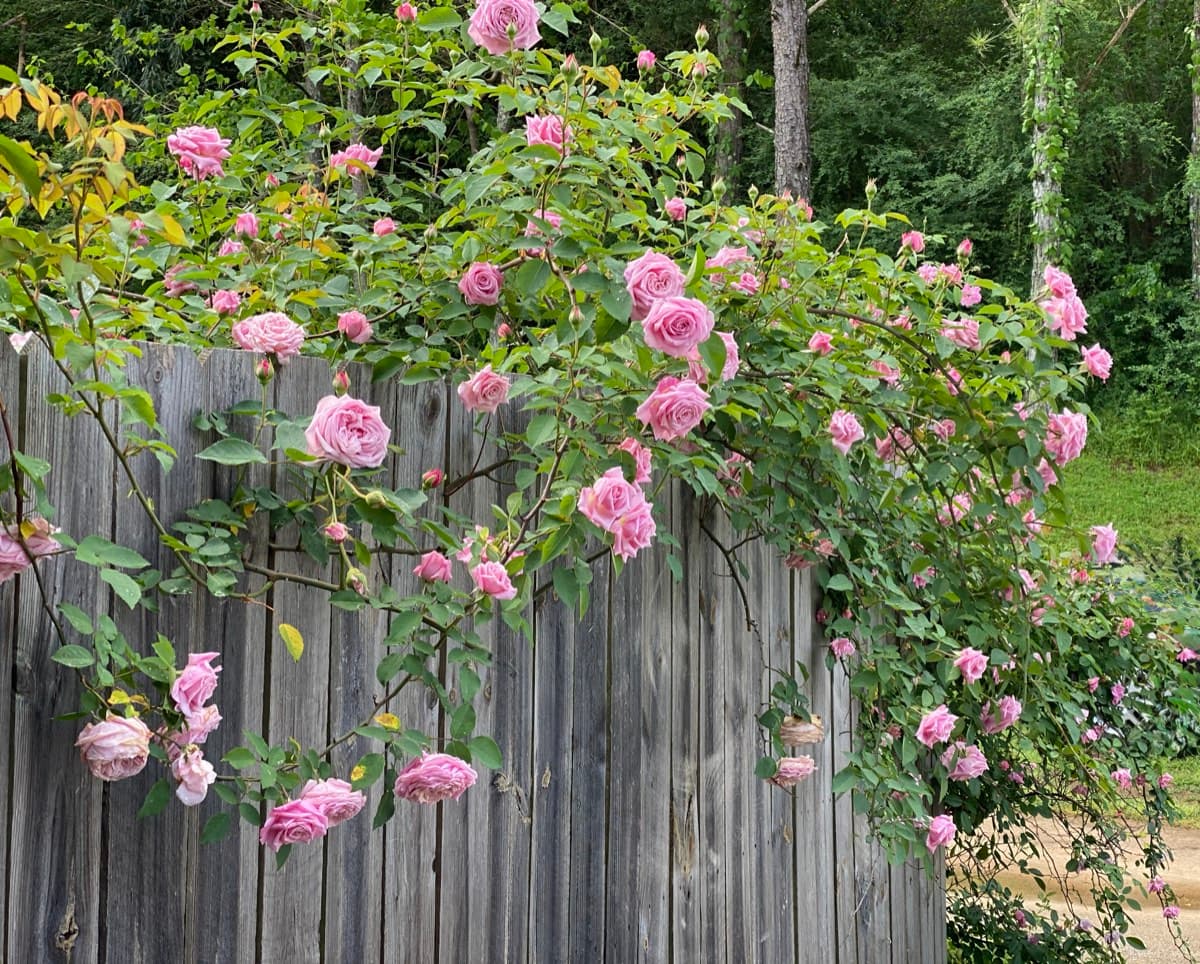
Here's one of the secrets to getting more flowers from a climbing rose: train the long canes horizontally or diagonally whenever the structure allows it.
A climbing rose naturally wants to send its strongest growth upward. If you simply let it grow straight up, you can end up with a tall rose with flowers concentrated toward the top. But when you train those long canes outward and sideways, you create more opportunities for flowering shoots along the length of the cane.
In simple terms: a vertical cane gives you height, a trained cane gives you flowers. That's one of the most useful principles you can learn when growing climbing roses.
Patience and Pantyhose
Now for one of my favorite climbing-rose tricks. Years ago, I contributed to an article for Southern Living called "Patience and Pantyhose." The title came from two things every climbing-rose gardener needs: patience, and, believe it or not, pantyhose.
No, I'm not kidding. Pantyhose make an excellent material for tying climbing roses to their supports, because they're soft, stretchy, and gentle on the canes. A stiff wire, plastic tie, or piece of string can cut into a growing rose cane as it expands. Pantyhose have enough give to hold the cane while allowing it to move and grow.
How to use pantyhose to tie climbing roses: take an old pair and cut them into strips. You don't need much. Wrap a strip loosely around the cane and support, creating a soft loop rather than pulling the cane tightly against the structure. The tie should support the cane without strangling it, and it shouldn't be so tight that the rose can't grow. That little bit of stretch is what makes pantyhose so useful.
The Redneck Rosarian Pro Tip: save your old pantyhose, your roses will thank you. It's inexpensive, it's reusable, it's gentle on the plant, and it's one of those old-fashioned garden tricks that just works. That's the kind of gardening advice I love.
Don't Be in a Hurry to Prune
When late winter arrives, your climbing rose may look downright ugly. There may be long, tangled canes. There may be bare sections. It may look like it desperately needs a haircut. Resist the urge.
If it's an established climber that blooms on old wood, those long canes may be carrying the flower buds for your spring display. Cut them away before flowering and you can't get those flowers back. Once the major flush of bloom has passed, then you can take a good look at the plant. That's when you decide what stays and what goes.
Training Is Not the Same as Pruning
This distinction is important. A climbing rose should be trained throughout the growing season, rather than repeatedly cut back. As long canes develop, gently position and tie them to the arbor, fence, trellis, or other support. You're creating the framework for future flowering.
Training is about positioning growth. Pruning is about removing growth. With climbing roses, training is often more important than pruning.
Give Your Climbing Rose Something Worth Climbing
This sounds obvious, but I've seen plenty of climbing roses planted beside structures that couldn't possibly support them. A mature climber can become a substantial plant, and that little decorative trellis that looks perfect when you plant a two-foot rose may not stand a chance three years later. Build the support for the mature rose, not the rose you bought today.
Consider:
- Arbors
- Pergolas
- Fences
- Heavy-duty trellises
- Cables
- Posts
- Garden walls
- Other permanent garden structures
And remember that roses don't actually climb like vines. They don't have tendrils. They need you to help them climb.
Climbers vs. Ramblers
The terms "climbing rose" and "rambler" are often used interchangeably. They shouldn't be.
Climbers generally produce long canes, and many varieties repeat bloom. Some examples include New Dawn, Peggy Martin, Farmers Dream, Mary Rose, Madame Alfred Carrière, Lamarque, Golden Gate, Altissimo, and Buff Beauty.
Ramblers tend to be more vigorous and often produce masses of smaller flowers in large clusters. Seven Sisters is a classic example. Many ramblers produce one spectacular display and then spend the rest of the season growing. And if you've got the room, a rambler can put on one heck of a show, but give it room. A rambler isn't something I'd tuck into a tiny bed beside the front door.
What About New Dawn?
Let's talk about the elephant in the Southern garden: 'New Dawn.' P. Allen Smith's line about Little Rock isn't entirely wrong. This rose has become a Southern garden institution for good reason. It's vigorous, beautiful, and capable of making a substantial display.
And that's precisely why it illustrates the point I'm making: know what you're buying. A climber isn't a little rose bush with a ladder, it's a structural element in the garden. 'New Dawn' can cover a fence, climb an arbor, and make a garden room out of an otherwise ordinary space. But give it the room and support it deserves.
Climbing Roses I Like for the Deep South
My Bulletproof Rose philosophy includes a number of climbing roses and ramblers that have demonstrated the toughness Southern gardeners need. Among the roses I particularly like for Southern gardens:
Pink climbers:
- New Dawn
- Peggy Martin
- Farmers Dream
- Mary Rose
Apricot and peach climbers:
- Buff Beauty
- Crépuscule
Yellow and gold:
- Golden Gate
- Lady Banks
White and cream:
- Lamarque
- Madame Alfred Carrière
- Sally Holmes
Red:
- Altissimo
Multicolor:
- Seven Sisters, a rambler
This isn't intended to be a definitive list of every good climbing rose. It's a starting point, and the list will continue to evolve as I grow more roses and learn more about how they perform in our climate.
How to Plant a Climbing Rose
The fundamentals are the same as planting other roses: sunshine, good drainage, good soil, and room to grow.
I recommend starting with the site rather than the rose. Give a climbing rose plenty of direct sunlight and soil that drains well, and don't plant a climber simply because there's an empty spot beside a fence. Ask yourself what that rose is going to become. A five-foot rose today could become a ten-foot or fifteen-foot rose tomorrow. Plan accordingly.
Bare-Root Climbing Roses
I'm a big fan of bare-root roses. When they arrive, I hydrate the roots before planting. My practice has been to soak bare-root roses for 24-48 hours before planting.
And don't get carried away trimming those roots. Those little feeder roots matter. The goal isn't to make the roots pretty, the goal is to get the plant established. Once planted, water it thoroughly and give that new climber time to establish its root system before expecting it to cover an arbor.
The First Year: Be Patient
This is where gardeners get impatient. You buy a climbing rose because you want a wall of flowers. The rose has other plans.
The first year is often about roots and framework. Let the rose establish itself. Encourage strong canes. Tie them to the structure. Don't constantly cut everything back because the plant doesn't look like the photograph on the tag. A climber needs time to become a climber, and today's growth can be tomorrow's flower show.
Deadheading Climbing Roses
Repeat-blooming climbers can benefit from deadheading. Removing spent flowers can encourage another flush of bloom. My general deadheading practice is to follow the stem down to a strong five-leaflet set and make the cut just above an outward-facing bud eye.
But don't turn deadheading into a religion. You don't need to stand over your climber every morning with pruners in hand. A rose garden is supposed to be enjoyed.
When Should You Prune Climbing Roses?
Here's where I want to depart from the simple "prune in late winter" advice that gets repeated in so many rose books. For climbers, the flowering habit is more important than the calendar. If your climbing rose blooms on old wood, you don't want to remove that old wood before it has a chance to flower.
Before the spring flush: leave the major canes alone. Train them. Tie them. Watch them. Wait.
After flowering: now you can evaluate the plant. Remove:
- Dead wood
- Diseased wood
- Damaged canes
- Very old, unproductive canes
- Crossing or rubbing growth
- Growth that's creating problems with the structure
Then retrain the remaining canes. This is especially important with once-blooming climbers and ramblers, which may put on their major show from growth produced the previous year.
A Simple Climbing Rose Pruning Calendar
Winter: don't panic. The plant may look messy, and that's okay. Inspect it and make sure the major canes are secure. Remove only what is clearly dead, damaged, or diseased if necessary.
Spring: let it bloom. This is especially important for old-wood bloomers. If you prune away the mature canes before flowering, you've potentially pruned away your spring display.
After flowering: now it's time to prune. Remove what needs to go and train the remaining canes.
Summer: train new growth. Tie long canes into the framework while they're young and flexible.
Fall: clean up, don't scalp. Remove dead or diseased material and secure the plant for winter.
One Thing I Don't Want You Doing
Don't give your climbing rose a fall haircut simply because the calendar says it's fall. And don't automatically give it a late-winter haircut because that's when you've always pruned your shrub roses. You can remove next year's flowers before you ever see them.
Southern roses have a different rhythm. Learn the rhythm of your particular rose.
Climbing Rose Care in the Deep South
There's nothing complicated here. Give your climbers sun, water, nutrition, good soil, air movement, and support. That's the recipe.
Remember that a mature climber has a much larger plant above ground than the little rose you brought home, and the roots need to support all of that growth. In the Deep South, consistent moisture during periods of heat and drought is particularly important, but don't keep the soil soggy. Roses like moisture. They don't like wet feet.
Air Circulation Matters
This is especially important for Southern gardeners. Heat and humidity create a wonderful environment for fungal disease. Don't create a solid wall of rose with no air movement, train the canes so the plant has room to breathe, and keep the base reasonably open. Remove diseased foliage and fallen leaves from around the plant.
One of my basic rose-care principles is simple: cleanliness matters. Removing diseased leaves and garden debris helps reduce the disease pressure waiting for you next season.
The Best Climbing Rose May Not Be the Prettiest
This is probably the most important lesson in the entire guide. A rose can be gorgeous in a catalog and miserable in your garden. I would much rather have a rose that performs than one that photographs well. That's why I developed the idea of Bulletproof Roses.
For a Southern gardener, toughness matters. Disease resistance matters. Heat tolerance matters. Drought tolerance matters. Repeat bloom matters. And longevity matters. Because the best rose isn't necessarily the newest rose, it's the one that comes back next year and does it all over again.
Designing a Garden With Climbing Roses
This is where climbing roses get really exciting. Don't think of them simply as plants. Think of them as garden architecture. A climber can:
- Frame a doorway — plant one on either side and train the canes upward and across
- Create a garden room — cover a pergola and suddenly you've got a destination
- Soften a fence — a plain wooden or iron fence becomes part of the garden
- Highlight an entrance — nothing says "come on in" quite like a rose-covered arbor
- Add height — climbers allow you to garden vertically, which is especially valuable in smaller gardens
Five Questions to Ask Before Buying a Climbing Rose
Before buying a climber, ask yourself five questions.
- How big will it get? Don't plant a monster beside a tiny gate.
- When does it bloom? Is it a once-blooming rose, a repeat bloomer, or does it flower primarily on old wood? Knowing the answer will determine how you care for it.
- Is it healthy in my climate? Don't assume a rose that performs beautifully somewhere else will love Alabama.
- What will support it? Have the structure ready before the rose gets big.
- What do I want it to accomplish? Screening, shade, a focal point, a garden entrance, or a wall of flowers — choose the rose based on the job.
The Golden Rule of Climbing Roses
If you remember nothing else from this guide, remember this: a climbing rose is not a shrub rose that happens to be tall. It has a different growth habit, it has different pruning requirements, and in many cases, it blooms on wood that was produced the year before.
That means those long, unruly canes aren't necessarily a problem. They're your flowers for next season. So before you cut, ask yourself: "Where is this rose going to bloom?" If the answer is "on that cane," put the pruners down.
A Final Word About Patience
I've been growing roses long enough to know that gardeners want everything immediately. I understand. We buy the rose, we plant it, we stand back, and we wonder why it isn't covering the arbor by Friday.
Give it time. A great climbing rose is an investment. The first season you see a plant. The second season you start seeing the framework. And then one spring you walk outside and realize that the rose has become part of the architecture of your garden. That's when you know you got it right.
That's the magic of climbing roses. They're not just roses that grow tall. They're roses that change the garden around them.
So plant the climber. Build the arbor. Train those canes. Tie them with something soft. Resist the urge to cut them back too soon. And then give the rose a little time to do what roses do best: grow.
Because when that first great flush of flowers finally covers the framework you've spent years building, you'll understand why we put up with a little unruly growth in the first place. A climbing rose isn't just a rose. It's a garden waiting to happen.
Quick Reference: Climbing Rose Care
- Best location: Full sun with good air circulation
- Soil: Well-drained soil rich in organic matter
- Support: Sturdy arbor, trellis, fence, pergola, or other permanent structure
- Training: Position long canes horizontally or diagonally when possible
- Ties: Use soft, flexible material such as strips of pantyhose
- Pruning: Know whether your climber blooms on old wood or new wood
- Old-wood bloomers: Avoid removing major flowering canes before their spring bloom
- Best pruning time: Generally after flowering for old-wood blooming climbers
- Southern consideration: Heat, humidity, and disease pressure make cultivar selection especially important
- Most important lesson: Train more. Prune less. And be patient.
Chris VanCleave, the Redneck Rosarian, is a nationally recognized rosarian, garden communicator, speaker, and advocate for roses. A lifelong gardener and longtime Southern rose grower, he has spent decades learning what works, and what doesn't, in the challenging climate of the Deep South.
His philosophy is simple: roses should be beautiful, but they should also be tough enough to live in a real garden. And sometimes the best gardening advice comes from the most unlikely places. Even the pantyhose drawer.
Rose Chat Podcast
Looking for more? The podcast has you covered.
Learn more on the Rose Chat Podcast, every other week.